
Most bicycle accidents involving light rail tracks look, at first, like the story of a single moment: a wheel drops into a gap, a rider falls, and the investigation appears to begin and end at the point of contact.
That framing is incomplete.
What I find when I conduct light rail bicycle accident analysis is that the conditions producing those incidents have almost always been developing for months or years before the crash.
The gap was known, or should have been. The measurement was missed, or not taken. The hazard was present in someone’s inspection record and never addressed.
The physical cause of the accident is not the analysis. It is the starting point. The analysis works backward through the failure chain: what condition existed, how long it had existed, what the agency’s own records say about it, and what the applicable standards required the agency to do.
For attorneys evaluating these cases, understanding that structure is essential. The liability question is almost never whether a hazard existed. It is whether the hazard was properly managed, and what the record shows about how that management was performed.
For a detailed discussion of how bicycle accidents involving light rail tracks occur from a physical standpoint, that analysis is addressed separately. This article focuses on the system-level failures that create the conditions for those incidents and how those failures are identified and evaluated in litigation.
Types of System Failures in Light Rail Operations

Track geometry and bicycle lane placement illustrate the design decisions at the center of light rail bicycle accident analysis.
System failures in light rail operations fall into four categories, and they rarely appear alone.
Design failures involve decisions made at the planning and engineering stage: where the track is placed relative to bicycle infrastructure, how the rail is embedded in street pavement, and whether the geometry of the installation accounts for the range of users who will encounter it.
A track alignment that places embedded rail at a shallow crossing angle to a bicycle lane is not a random outcome. It is a decision, and it is one that can be evaluated against engineering standards and the agency’s own design review documentation.
Maintenance failures are the category I find most frequently documented in the records produced in discovery.
A flangeway gap, the opening in embedded street track that allows the rail wheel flange to pass through but is wide enough to trap a bicycle wheel, is not static.
With girder rail the opening is rolled directly into the steel section. With T-rail embedded in concrete, it is formed in the surrounding pour. Either way, the gap widens over time as the steel wheel flange wears against the steel or concrete wall forming the flangeway, gradually opening it beyond its original dimension.
Agencies that are managing their infrastructure properly measure those gaps on a defined schedule and act when measurements fall outside permitted tolerances. What I commonly find instead is a maintenance log that contains no entry for flangeway measurement at all, or entries that document a condition without any follow-up corrective action.
Operational failures involve the decisions made by agency personnel about how to manage known conditions.
When a supervisor receives a report of a hazard and closes the entry without documented verification of corrective action, that is an operational failure. When a safety concern raised by an operator is logged and then not acted upon, that is an operational failure. These are management decisions, and they appear in the record.
Safety management failures involve the agency’s formal systems for identifying, tracking, and mitigating hazards.
A properly functioning safety management program does not simply react to incidents. It identifies hazards before incidents occur, assesses their risk, and documents what was done to address them.
When I review an agency’s Public Transportation Agency Safety Plan (PTASP), the formal document that Federal Transit Administration (FTA)-funded agencies operating fixed guideway systems subject to State Safety Oversight are required to maintain, and I do not find the relevant hazard category addressed, that is a systemic failure, not an oversight.
Failure Chain Analysis
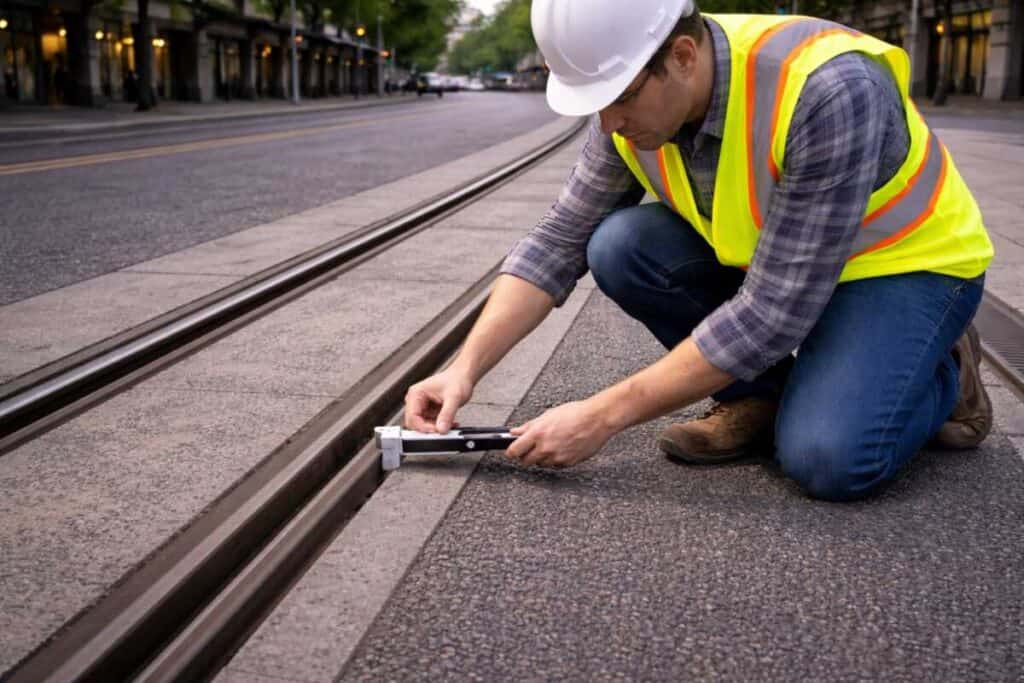
Incidents in transit operations are almost never caused by a single point of failure. What produces an accident is a chain of conditions and decisions that accumulate over time, each one a missed opportunity to interrupt the sequence before it ends in an injury. Understanding that chain is the core of what I do in system failure analysis.
The chain typically begins well before the incident date.
A track section is installed with a design that creates some baseline level of exposure for cyclists. The pavement around the embedded rail begins to wear. Inspection schedules that should detect that deterioration are either not followed or not documented.
A gap that was at tolerance on installation has widened to a dimension that presents a genuine entrapment hazard, and the record contains no measurement to show anyone checked. An operator or a member of the public reports a concern, and the entry is closed without evidence that anyone physically verified the condition. Then someone falls.
The engineering question in failure chain analysis is not simply what condition existed at the time of the incident. It is when that condition became hazardous, whether it was detectable through reasonable inspection practices, and what the record shows about whether anyone was looking.
When a condition develops progressively, which pavement wear and flangeway widening always do, the inference is available that the hazard was present and developing for a period before the incident. The maintenance record either supports or contradicts that inference.
The failure to act is frequently more significant than the original design. A marginal design that is properly monitored and corrected when it deteriorates is a managed risk. The same design, ignored until someone is injured, is a different matter entirely.
Maintenance and Inspection Failures
In the maintenance records produced in discovery, absence is often the most important finding. An agency that is properly managing embedded track infrastructure will have measurement records: dates, locations, gap dimensions, and documentation of corrective action when measurements fall outside tolerance.
When I ask for those records and they do not exist, that absence is itself a finding. It tells me that the measurement program was not functioning, which tells me that the hazard management program was not functioning.
I have reviewed maintenance logs in litigation where a specific track section was flagged for condition concerns but the corrective action entry was closed with no documented evidence of physical inspection or repair.
A log entry marked resolved without documentation of what was done does not show that the condition was corrected. It shows that the entry was administratively closed. That distinction matters in litigation.
Missing or incomplete records present their own evidentiary problem for agencies. When a party cannot produce documentation showing that required inspections were performed, the inference available to the factfinder is that those inspections were not performed.
Agencies cannot fill the gap after an incident with retroactive assertions about their practices. The record is the record. That gap between what the maintenance program required and what the maintenance log shows is where the analysis begins.
Safety Management and PTASP Failures
A functioning safety management system does not wait for an incident to identify a hazard. It maintains a proactive process for identifying conditions that could produce an incident, assessing the risk those conditions present, documenting what mitigation is in place, and tracking whether that mitigation is actually working.
The Public Transportation Agency Safety Plan (PTASP) is the formal expression of that program for FTA-funded agencies operating fixed guideway systems subject to State Safety Oversight.
When I review a PTASP in the context of a bicycle accident case, I am looking for specific things: whether the hazard category is addressed, what risk controls are identified, and whether the corrective action record shows those controls were actually implemented.
What I frequently find is a safety plan that addresses the hazard category in general terms without demonstrating that the agency actually conducted the hazard identification process, assessed the specific risk, and implemented documented controls.
A safety plan that says the agency conducts regular track inspections is not the same as a safety plan supported by inspection records showing that those inspections were conducted, what they found, and what was done about it. The document and the record have to align. When they do not, that misalignment is material.
Agencies that have failed to identify a recurring hazard type in their safety management process have also, by definition, failed to apply their own corrective action procedures to it.
That is a systemic failure. Monitoring a known hazard category without documented corrective action is not the same as managing it.
Documentation and Evidence in Failure Analysis

The documentary record in a light rail system failure case tells the story.
My job is to read that record carefully enough to follow the thread it contains.
The documents I review in these cases include maintenance logs and inspection records for the specific track section, the agency’s PTASP and any hazard identification documentation, prior incident reports involving the same location or the same hazard type, and internal communications about track condition or safety concerns.
I also review design documents and as-built drawings for the installation, and training records for maintenance personnel whose responsibilities included the affected infrastructure.
Prior incident reports are particularly significant. When an agency has a record of prior complaints, near-misses, or injury incidents at the same location or involving the same hazard type, and the record does not show that those prior events triggered a documented corrective action review, that is evidence of a systemic failure rather than an isolated oversight.
I have seen cases where the same intersection appears in the incident log three times before the litigation incident. The question that record raises is what, if anything, the agency did differently after the first two.
Internal communications, where they are produced in discovery, sometimes contain the clearest statements of what agency personnel knew and when they knew it.
An email from a supervisor acknowledging a track condition concern is more direct than any inference from an inspection log. When those communications exist and are produced, they typically become central to the analysis.
Organizational Responsibility
Transit agency responsibility for track infrastructure conditions is not a simple question in every case.
Many agencies contract out maintenance functions, and the contractual allocation of maintenance obligations affects where responsibility sits in the organizational structure.
I review the operating and maintenance contract carefully in these cases, specifically the technical provisions governing track inspection, gap measurement requirements, and corrective action obligations.
When a contractor was responsible for maintenance and the maintenance was not performed, the question becomes whether the agency was fulfilling its oversight obligations under the contract.
Engineers involved in the original design bear responsibility for decisions made at the design stage: the track geometry, the embedding specification, and whether the design adequately accounted for the range of users who will encounter it.
When a design produces a geometry that is inherently difficult to maintain within safe tolerances, that is a design issue that belongs in the failure analysis alongside the maintenance record.
Responsibility in these cases frequently runs across multiple parties. The agency that owns the infrastructure, the contractor that maintained it, and the engineers who designed it may each have contributed to the conditions that produced the incident.
My role is to evaluate each party’s contribution to the failure chain based on what the record shows about their respective obligations and what the record shows about how those obligations were performed.
Expert Analysis in These Incidents
When I am retained to conduct system failure analysis in a light rail bicycle accident case, I begin with the documentary record and work forward from it.
I review the maintenance and inspection records for the affected track section, identify what measurements were taken and when, and compare those measurements against the applicable tolerances.
Where measurements are absent, I note the gap in the record and assess what a properly functioning inspection program should have produced during that period.
I then review the agency’s safety management documentation to evaluate whether the hazard type was identified, what risk controls were documented, and whether those controls were actually implemented. I compare what the PTASP says the agency does against what the maintenance record shows the agency actually did.
I have spent 41 years safety-certifying, operating, and maintaining transit systems. When I read a maintenance program document, I know what a functioning program looks like, and I know what a program that exists on paper looks like. The records usually make that distinction clear.
I also assess the design decisions embedded in the original installation, particularly where the geometry of the track relative to adjacent bicycle infrastructure created conditions that required active management to remain within safe tolerances. Where the design itself contributed to the failure chain, that contribution belongs in the analysis.
The output of my analysis is an engineering opinion that reconstructs the failure chain, identifies each contributing factor, evaluates compliance with applicable standards, and explains what a properly functioning system should have produced at each decision point. That opinion is grounded in the documentary record and in 41 years of direct operational experience with the systems I am evaluating.
When Attorneys Engage an Expert Witness
System failure analysis is appropriate in any bicycle accident case where the physical cause is established but the liability picture requires examination of what the agency knew, what it should have known, and what it did or failed to do with that knowledge.
If the only question is how the accident happened, the physical investigation may be sufficient. If the question is whether the agency properly managed a known or knowable hazard, that question requires system-level analysis.
Attorneys benefit from engaging an expert early in these cases. The documentary record that makes system failure analysis possible is produced in discovery, and knowing what to ask for, and in what form, requires an understanding of how transit agencies document their maintenance and safety management activities.
I can assist counsel in framing discovery requests that capture the relevant records, including maintenance logs, inspection databases, prior incident reports, corrective action documentation, and internal communications about track condition concerns.
Cases where prior incidents at the same location are known or suspected are particularly strong candidates for system failure analysis. When a hazard has already produced an incident and the record does not show a documented response, the agency’s awareness of the risk is substantially easier to establish.
Frequently Asked Questions

What is the difference between a physical cause analysis and a system failure analysis?
Physical cause analysis identifies the mechanical condition that produced the incident, such as a flangeway gap outside dimensional tolerance.
System failure analysis works backward from that condition to evaluate how it developed, whether the agency’s maintenance program should have detected and corrected it, and whether the safety management system was functioning as required.
Both analyses are frequently necessary, but they answer different questions. The liability question in most of these cases lives in the system failure analysis.
How does absence of maintenance records affect the analysis?
Absence of required inspection records is itself a finding. It demonstrates that the measurement program was not functioning during the period when those records should have been produced. Agencies cannot reconstruct a maintenance history after an incident with general assertions about their practices.
The record is what it is, and when required documentation does not exist, that gap carries weight in the analysis and in the evaluation of the agency’s compliance with its own program obligations.
What does a properly functioning PTASP look like in the context of embedded track hazards?
A functioning PTASP identifies the specific hazard category, documents the risk assessment process, identifies the controls in place to manage the risk, and includes a corrective action record demonstrating that those controls were actually implemented and reviewed for effectiveness.
A PTASP that describes inspection practices in general terms but is unsupported by inspection records is a safety plan that exists on paper. Those are very different things, and the distinction is significant in litigation.
Can responsibility be shared across multiple parties in these cases?
Yes. The design engineer, the contracting agency, and the maintenance contractor may each carry responsibility depending on what the record shows about their respective obligations and performance. I evaluate each party’s contribution to the failure chain based on the documentary record: the design documents, the maintenance contract’s technical provisions, and the inspection and corrective action records attributable to each party. The record usually makes the allocation of responsibility clearer than the parties would like it to be.
Bicycle accidents on light rail tracks are rarely isolated events. The conditions that produce them develop over time and are, in almost every case I have reviewed, reflected in the documentary record.
The maintenance log that contains no measurement entry, the safety plan that identifies the hazard category but shows no corrective action, the prior incident that triggered no documented response: these are not absences.
They are findings. Light rail system failure analysis reads those findings clearly, traces them through the failure chain, and produces engineering opinions grounded in what the record actually shows. That analysis is what tells an attorney whether the case is about a random accident or about how a system was managed.