Light Rail Systems Expert Witness (Includes Streetcars & Trolleys)

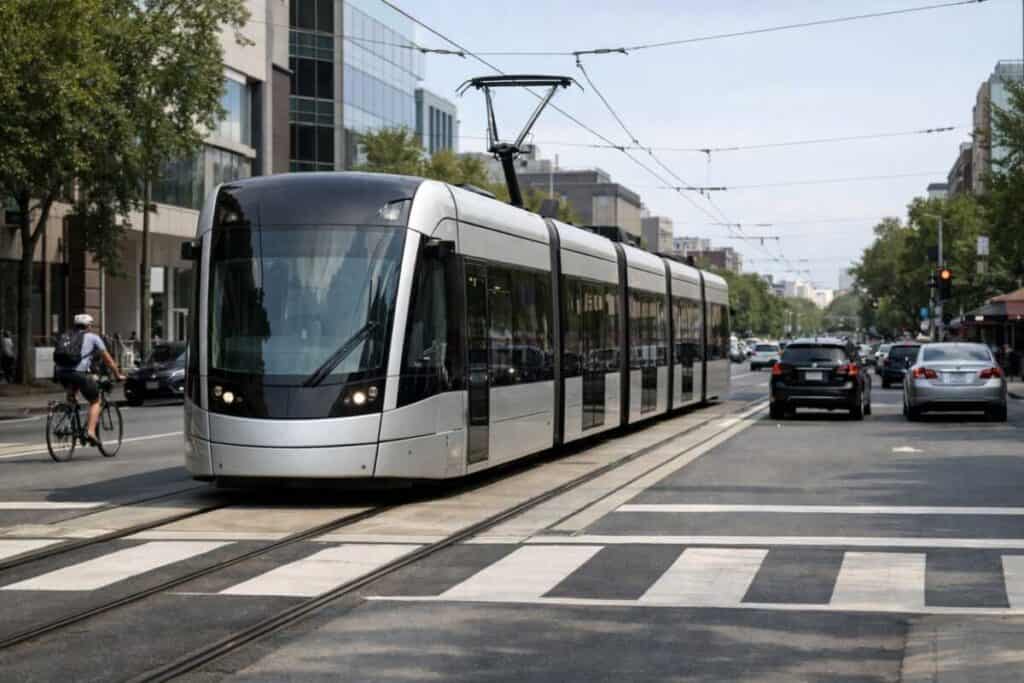
Light rail systems have been my professional life for more than 40 years. I have operated them, certified them for safety, investigated accidents on them, helped design vehicles for them, and contributed to the industry standards that govern them.
When attorneys need a light rail systems expert witness, that depth of direct experience is what distinguishes useful expert analysis from general transit knowledge.
Light rail transit encompasses electrically powered passenger rail vehicles operating on fixed tracks in urban environments, including modern light rail systems, street-running streetcars, and heritage and tourist trolley operations.
These systems share road space with pedestrians, cyclists, and motor vehicles far more than conventional subway or commuter rail, and that exposure is precisely what generates the litigation I am retained to analyze.
The technical issues in light rail litigation involve operating rules, signal systems, maintenance records, vehicle systems, embedded track design, operator training, and the safety standards established by the Federal Transit Administration, the American Public Transportation Association, and the agency’s own governing documents.
I work with both plaintiff and defense counsel. My opinions are formed from the evidence and the applicable standards, and they do not change based on who retained me.
Light Rail Systems in Litigation
Light rail incidents produce a wide and technically varied range of litigation. The cases I am most frequently retained to analyze fall into several distinct categories, each involving specific technical questions that require specialist knowledge to evaluate properly.
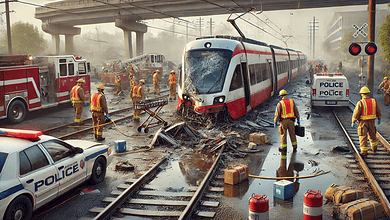
Collisions between light rail vehicles and motor vehicles are among the most common.
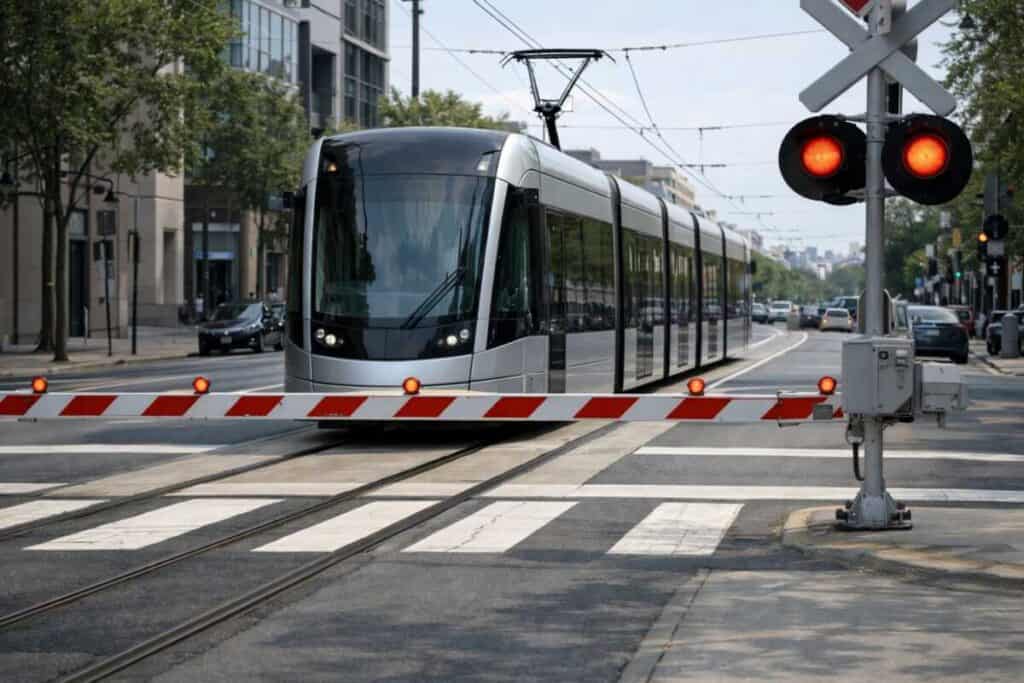
These cases involve grade crossing protection systems, signal preemption (the technology that clears traffic signals ahead of an approaching train), sight-line adequacy, operator response, and vehicle stopping distances.
Understanding what the system was designed to do and what the record shows it actually did is central to every collision case I analyze.
Pedestrian strikes occur at crossings, along at-grade alignments, and at station platforms. Bicycle incidents involving flangeway gaps are a category I have particular experience in, including expert engagements in Cincinnati, Ohio and Oklahoma City, Oklahoma.
A flangeway gap is the narrow slot cut into embedded street track that allows the rail wheel flange to pass through. It is wide enough to trap a bicycle wheel, a wheelchair caster, or a pedestrian’s heel and cause a sudden and serious fall.
The design, maintenance, and hazard mitigation obligations around flangeway gaps are governed by FTA requirements and State Safety Oversight conditions, and by the specific obligations each agency has accepted within its own Public Transportation Agency Safety Plan. I have worked directly on these systems and on the safety plans that govern them..
Passenger injury cases arise from falls during boarding, alighting, and riding, door incidents, sudden braking events, and platform edge accidents.
Derailments, though less frequent on modern systems, occur and involve specific questions around track geometry, wheel and rail interface conditions including gauge variations and profile mismatches between the wheel and the rail, vehicle dynamics, and maintenance history
Operator error cases, overspeed incidents, and violations of the system’s own operating rules are analyzed through event recorder data, dispatch logs, training records, and the agency’s operating rule documentation.
Grade crossing warning device failures, overhead wire and electrical system incidents, and cases involving track workers and right-of-way safety are also within the scope of my practice.
Each of these case types involves technical questions that go beyond general transportation knowledge. That is why specialized light-rail expert analysis is necessary and why the depth of experience behind it matters.
Common Causes of Light Rail Accidents
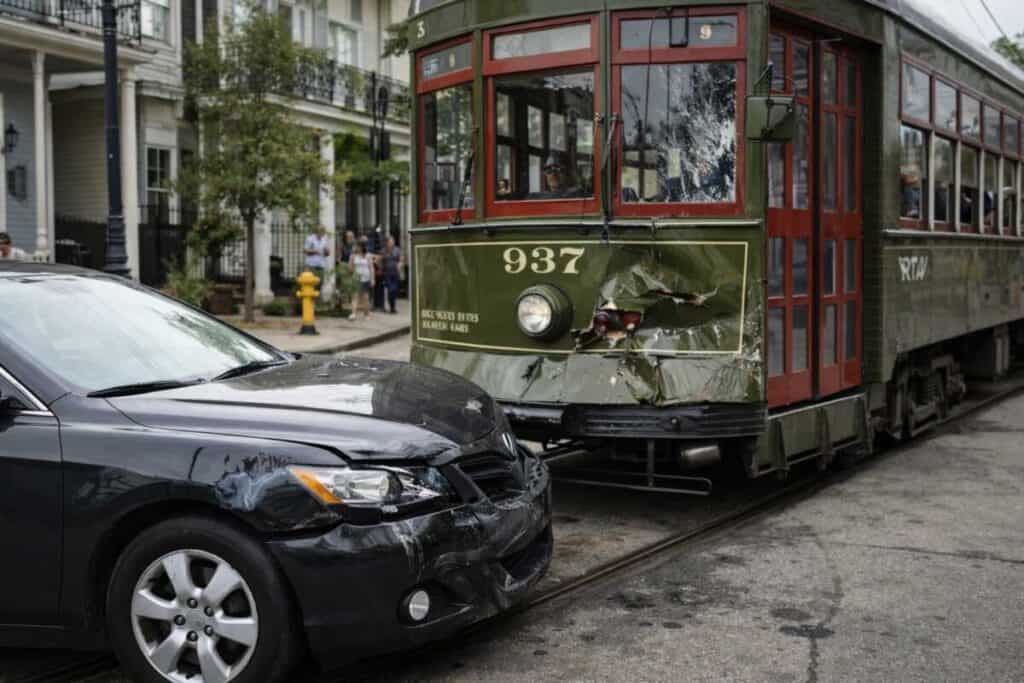
Understanding what happened in a light rail incident is only part of the analysis. Understanding why it happened, and whether it should have been prevented, is where standard of care becomes the central issue for litigation.
The causes I examine most frequently include inadequate operator training or supervision, failure to follow the agency’s own operating rules and speed restrictions, and grade crossing protection failures including signal timing errors, preemption system malfunctions, and inadequate advance warning.
Maintenance deficiencies, deferred repairs, and track defects, including gauge irregularities, worn rail, and compromised embedded track surfaces, are recurring causes in both vehicle and pedestrian incident cases.
Signal system failures, human factors issues such as sight-line obstructions, inadequate lighting, and warning deficiencies, and agency safety program failures are the broader organizational causes that connect individual failures to systemic liability.
A safety program failure means the agency’s own systems for identifying, managing, and correcting known risks broke down. That breakdown is often where the most significant liability analysis lies, because it shows not an isolated mistake but a pattern the agency was in a position to prevent.
Streetcar and Trolley Systems
Modern Light Rail Transit Systems
Modern light rail transit systems typically operate on a combination of dedicated right-of-way, meaning track reserved exclusively for the rail vehicle, and street-level segments shared with other traffic.
They are governed by Federal Transit Administration safety oversight requirements and operate under formal system safety programs with defined standards for vehicle performance, signal systems, and platform design.
I have been involved in the safety certification and entry into revenue service of major modern light rail and streetcar systems throughout my career.
These include the DC Streetcar, the Memphis Trolley, and the Atlanta Streetcar, where I served as Deputy Commissioner and Executive Director, creating the agency from the ground up with a $100 million capital budget.
I also managed the startup, operations, and maintenance of the Tampa streetcar system for six years at the Hillsborough Area Regional Transit Authority.
Light rail and streetcar systems are the mode I have worked with most consistently across my 41 year career, and they are the cases I am most frequently retained to analyze in litigation.
Street Running Streetcar Systems
Street running streetcars operate almost entirely in mixed traffic, sharing lanes with motor vehicles and crossing pedestrian paths continuously.
Embedded rail, where the track is set flush into the road surface, creates specific hazards including flangeway gaps and surface irregularities that affect both vehicle traction and pedestrians.
I managed the startup, operations, and maintenance of Tampa’s streetcar system for six years at the Hillsborough Area Regional Transit Authority. That direct operational experience informs the expert witness analysis I have provided in streetcar infrastructure and flangeway cases, including matters in Cincinnati, Ohio, and Oklahoma City, Oklahoma.
I have also served as Chair of the APTA Streetcar Subcommittee and as a member of the APTA Embedded Track Working Group, which gives me direct knowledge of the standards and accepted practices that govern these systems.
Heritage and Tourist Trolley Operations
Heritage and tourist trolley systems operate older or replicated older equipment, often on historic routes, that may be subject to different safety expectations and regulatory frameworks than modern light rail.
I managed the St. Louis Delmar Loop Trolley project, directed operations and maintenance of the 33-tram Bendigo Tramways system in Victoria, Australia, and am a credited participant in the APTA Vintage and Heritage Trolley Vehicle Equipment Standard.
The standard of care analysis in heritage trolley cases requires understanding both which standards apply and which standards the operating agency has adopted for itself.
I am a credited participant in the APTA Vintage and Heritage Trolley Vehicle Equipment Standard, meaning I contributed directly to its development. When that standard is cited in litigation, I do not need to interpret it from the outside.
Technical Evidence Examined in Light Rail Cases
Every light rail case is shaped by its own facts, but the categories of evidence I examine are consistent across the full range of light rail litigation.
Knowing what to look for, what should exist, and what its absence means, and how to read technical records against the applicable standards is the core of what I provide.
I begin with event data recorder information, the onboard systems that log speed, braking, door operations, and other vehicle functions throughout every trip. These records often tell a more complete and objective story than any witness account.
Onboard and fixed infrastructure CCTV footage from vehicles, stations, and crossing locations is reviewed alongside that data, and I assess whether proper preservation steps were taken immediately after the incident. The absence of records that should exist is itself significant evidence.
Operating rules and standard operating procedures establish the baseline against which operator and agency conduct is measured. They define what the agency required of its operators and maintenance personnel at the time of the incident.
Maintenance and inspection records tell me whether required work was completed on schedule, whether known defects were identified and addressed, and whether the vehicle and track were in the condition they should have been.
Operator training and certification records, including simulator hours, recertification history, and any documented performance concerns, are standard subjects of review in every operator conduct case.
Track geometry inspection reports document the measured condition of the rail, the alignment, the gauge (the distance between the two rails), and the surface condition at regular intervals.
Signal system and grade crossing maintenance records establish whether warning devices were functioning and properly maintained.
Dispatch and control center logs, which record every communication between operators and supervisors, reveal what the agency knew and when.
Prior incident and near-miss reports involving the same location, the same vehicle, or the same system component are among the most significant evidence in light rail cases. A documented pattern of prior incidents the agency knew about and did not adequately address is frequently central to both liability and damages analysis.
Human factors analysis brings the technical findings together in terms a jury can understand. It addresses visibility conditions, the adequacy of warnings, operator workload, reaction time expectations, and the design of cab controls and passenger interfaces.
In litigation, it translates what the engineering record shows into plain language that explains why a trained operator in that situation, with that information, should or should not have acted differently.
Light Rail Safety Standards and Regulatory Compliance
Light rail systems operate under layered safety obligations, and understanding those layers is essential to building a standard of care argument in litigation.
Federal Transit Administration oversight establishes minimum requirements for system safety planning, hazard management, and incident investigation through its State Safety Oversight program.
Light rail agencies that receive Federal Transit Administration funding and operate under State Safety Oversight requirements are required to maintain a formal written safety document.
Depending on the agency and the regulatory period, you may encounter it as a System Safety Program Plan, a System Safety Plan, or under the current federal framework introduced in 2018, a Public Transportation Agency Safety Plan.
The title matters less than the substance. It is the agency’s written commitment to how it identifies and manages safety risk, and it is one of the first documents I request in any light rail case where it applies.
American Public Transportation Association standards and recommended practices provide a further framework for accepted industry practice.
I have been directly involved in the development of two APTA standards documents: the Modern Streetcar Vehicle Guideline, APTA RT-ST-GL-001-13, and the Vintage and Heritage Trolley Vehicle Equipment Standard, APTA RT-SCS-S-001-05.
When these documents are at issue in litigation, I am not citing external standards. I am explaining standards I helped write.
When an agency has adopted APTA standards or referenced them in its own procedures, those documents become directly relevant to liability analysis regardless of whether any regulator required them to do so.
For embedded track in street running environments, there are specific dimensional standards governing the wheel and rail interface, including flange width, flange height, and flangeway width and depth. These are measurable, documented requirements.
When an agency has accepted those dimensional standards as part of its system approval process and they have been reviewed and approved by FTA and its State Safety Oversight agency, those dimensions become enforceable obligations.
If the as-built condition of the track, or its condition after years of wear and deferred maintenance, falls outside those accepted dimensions, that deviation is documentable and directly relevant to liability analysis.
In flangeway gap cases specifically, the difference between the approved dimension and the actual measured condition at the time of an incident is often where the critical analysis lies.
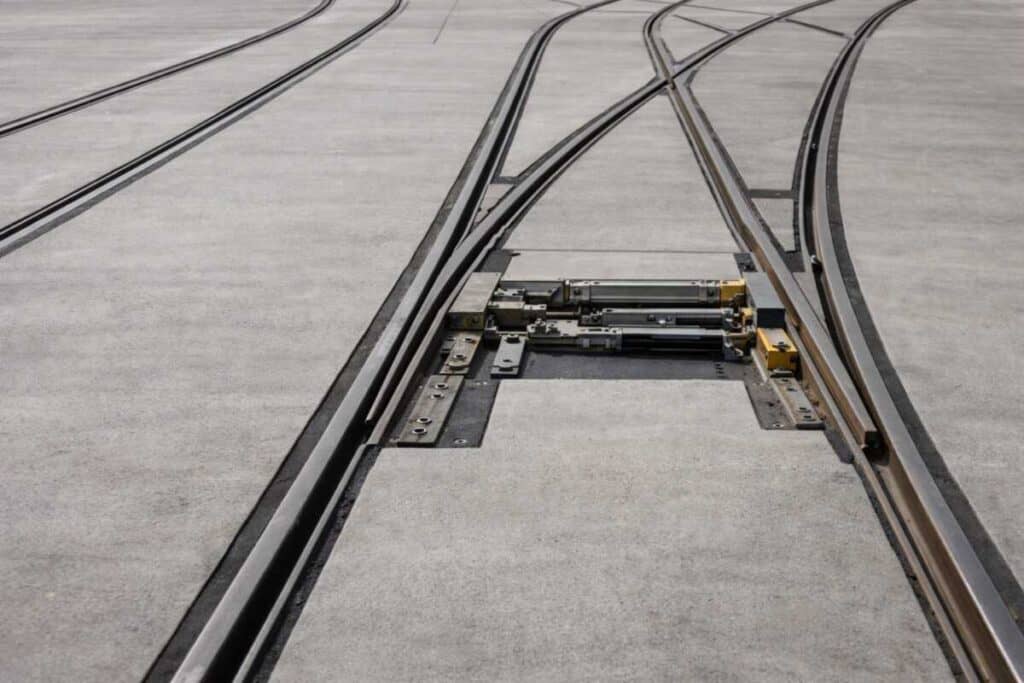
For cases involving track and infrastructure more broadly, American Railway Engineering and Maintenance-of-Way Association standards, known as AREMA, provide the technical framework for track geometry, rail condition, and switch design requirements.
The practical question in litigation is not whether a dense regulatory framework was technically violated. It is whether the agency and its personnel met the obligations that they, or the FTA and State Safety Oversight, set for them, and that the industry recognizes as reasonable.
My Role as a Light Rail Expert Witness
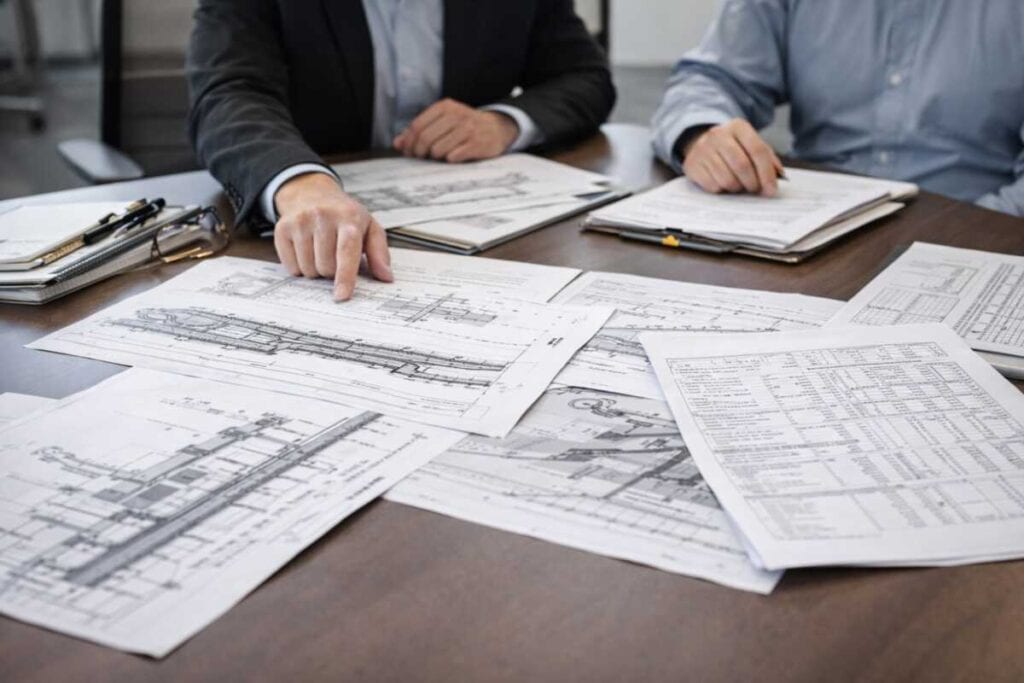
Engagement begins with an initial case review. I evaluate the incident description and the available records to form an early assessment of the technical issues likely to matter.
That early assessment helps counsel understand what they are dealing with before significant discovery resources have been committed.
In light rail cases, knowing what records to request and recognizing when something that should exist is missing is often where the most important work happens.
As the case develops, I conduct a detailed analysis of maintenance records, operating rules, training documentation, event recorder data, and video evidence. Where the physical condition of track, a crossing, a platform, or a warning system is material to the case, I may conduct site inspections.
I have worked on light rail systems across the United States, Canada, and Australia in consulting, operational, and management roles, which means site inspections are not abstract reviews. I know what I am looking at and what should be there.
Expert reports are prepared to meet applicable court requirements and written to withstand rigorous cross-examination. I write to explain the evidence clearly and accurately, not to advocate for a result.
Rebuttal reports address the opinions of opposing experts, identifying methodological weaknesses and conclusions that are inconsistent with the technical record and the applicable standards.
I provide deposition support, prepare counsel on the technical subject matter, and give expert testimony at deposition and trial.
I work for plaintiff and defense counsel. My opinions follow the evidence. They do not change based on who retained me.
Related Transit Expert Witness Services
This page addresses light rail, streetcar, and trolley litigation specifically. For transit matters involving other modes, I maintain dedicated pages covering the technical and operational issues particular to each system type.
The Transit Systems Expert Witness article covers the full range of fixed-guideway and rubber-tired transit modes and serves as the broader hub for all transit litigation matters.
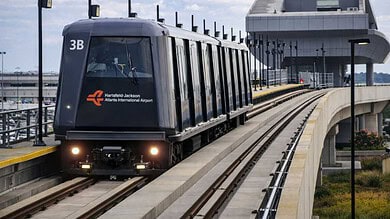
The Automated People Mover Expert Witness article addresses airport APM and plane train litigation, including the specialized regulatory framework and standards that apply to those systems.
The Transit Bus Systems Expert Witness article covers public transit bus operations, passenger injury claims, ADA compliance, and fleet maintenance issues.
Cases involving multiple transit modes, or where the classification of the system is itself in dispute, are addressed through the full scope of my transit systems experience.
Contact and Case Review
Light rail is not one area of my practice. It is the foundation of my entire professional career.
If you are evaluating expert retention for a light rail, streetcar, or trolley matter, I welcome an initial conversation about the technical issues in your case.
Early expert review assists with case evaluation, discovery planning, and identification of the records that matter before they become difficult to obtain.
All initial consultations are confidential. Contact National Transit Services, LLC to discuss your case.