The World’s Biggest & Busiest Airport Automated People Movers (2026)


Airport Automated People Movers
Automated People Movers (APMs), often nicknamed “plane trains” are now part of the fabric of modern airports. From Atlanta’s iconic Plane Train to the sprawling AirTrain JFK in New York, these driverless systems quietly move hundreds of millions of passengers annually. They’re fast, frequent, and designed to handle the unique challenge of airports: high volumes of people with tight deadlines.
What Makes an Airport People Mover?
Though each airport tailors its APM to local conditions, most share a set of common characteristics:
- Dedicated guideways: APMs run on exclusive tracks underground, elevated, or in tunnels, never mixing with road traffic. This keeps operations predictable and safe.
- Automated control: The vehicles are driverless, with computers managing acceleration, braking, and spacing. This allows headways as short as 90 seconds in some systems.
- Short distances, high frequency: Unlike city rail networks, airport APMs usually cover just 2–8 miles. But they run constantly, often 20–24 hours a day, with minimal waiting times.
- High throughput: Because airports funnel huge crowds through narrow corridors, these systems are designed to move tens of thousands of passengers per hour during peak travel.
- Integration with terminal design: Stations are built right into concourses, rental car centers, and ground transport hubs, allowing step-free transfers with luggage.
- Resilience and redundancy: Many APMs run in loops or parallel guideways so a breakdown in one train doesn’t halt the system.
These conditions have made APMs the natural solution for modern hubs where walking distances would otherwise be impractical.
Top 5 by Ridership
The busiest systems are those embedded directly in the passenger flow, where riders have no alternative.
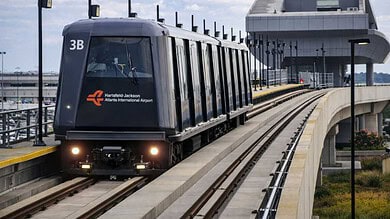
- Atlanta (ATL) – Plane Train: ~91M riders per year, ~250,000 daily. Underground, nonstop between concourses, and the undisputed champion of airport APM ridership.
- New York (JFK) – AirTrain: ~25M riders per year. Connects all JFK terminals with parking and rail links, making it both an airport circulator and a regional connector.
- London Heathrow (LHR) – Terminal 5 Transit: ~13M riders annually. Connects Terminal 5’s main building to its satellite terminals via an underground automated link.
- Paris Charles de Gaulle (CDG) – CDGVAL: ~10M riders annually, linking terminals and train stations.
- Phoenix (PHX) – Sky Train: ~15,900 daily (~5.8M annually). Still smaller than the giants but growing steadily as extensions open.

Top 5 by Length of Track
Not every APM is short and simple. Some cover entire airports with long guideways.
- JFK AirTrain: 8.1 miles (13.0 km). Longest in the world, doubling as a link into the city’s transit system.
- Dallas–Fort Worth (DFW) Skylink: 4.81 miles (7.74 km). A large airside loop linking DFW’s terminals.
- Singapore Changi – Skytrain: 4.0 miles (6.4 km). Moves passengers between multiple terminals at the consistently top-ranked airport.
- San Francisco (SFO) – AirTrain: 3.0 miles (4.8 km). Two lines circling the terminals and rental car center.
- Atlanta (ATL) – Plane Train: 2.8 miles (4.5 km). Shorter than some but moves far more people.
Legacy Systems
The very first airport APM appeared in Tampa, Florida (TPA) in 1971. The original Westinghouse Skybus-based system ran between the main terminal and satellite airsides. Tampa’s model was revolutionary: fully automated, short-haul, and integrated into the terminal design from the beginning. Nearly every large airport APM today traces its design philosophy back to Tampa’s template.

New Systems & Expansions
- Los Angeles (LAX) People Mover: currently in final construction phases with opening anticipated in 2026, linking terminals with a consolidated rental car center and Metro rail.
- Orlando (MCO): Continues to add modernized APMs as its South Terminal grows.
- Doha (DOH) and Dubai (DXB): Expanding fleets to handle booming Middle Eastern hub traffic.
These projects show that APMs aren’t a luxury anymore, they’re critical infrastructure for airports competing on passenger experience.
Why They Matter
Airport people movers are the invisible workhorses of aviation. They’re rarely the reason someone remembers an airport, but they make everything work: fast transfers, on-time connections, and predictable flows. Without them, modern mega-hubs would simply grind to a halt.
How They’re Regulated in the U.S.
In the United States, airport APMs are regulated through a combination of local airport authority oversight, state DOT involvement where applicable, and compliance with technical standards including ASCE 21 Automated People Mover Standards, NFPA 130 fire safety codes, and ADA accessibility requirements.
Unlike FTA-funded public transit, most airport APMs fall outside direct federal transit oversight, responsibility rests primarily with the Authority Having Jurisdiction (AHJ). Airports typically contract with Independent Safety Assessors (ISAs) to verify compliance before opening.
These rules exist because APMs are unlike escalators or moving walkways; they’re full transit systems with moving vehicles, signals, and emergency protocols. Regular audits and certification reviews ensure they operate safely as airports expand and modernize.
The Importance of Expert Witnesses
When something goes wrong, an incident, a delay in certification, or a dispute over design and operations attorneys and courts often turn to transit experts. An expert witness can explain whether an APM met safety standards, whether operating practices were adequate, and whether maintenance logs reflect good industry practice. Their testimony helps clarify liability in accidents and ensures accountability in projects worth billions of dollars.
As airports continue to expand APMs, the role of technical experts will only grow, bridging the gap between complex engineering standards and the legal system.
Please Note
- All data reflects the most recent published sources available at the time of writing.
- Ridership, fleet, and track length figures vary year by year and may change as airports expand.
- Some large airports do not publish full APM statistics, so rankings are based on the best available information.