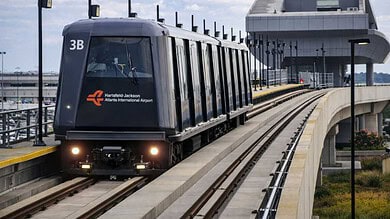
Airport Plane Trains: Definition, Safety and Legal Explanations for 2026


What Is a Plane Train?
If you’ve flown through Atlanta, Denver, or Orlando, you’ve probably stepped onto what travelers casually call a plane train. The correct industry term is an Automated People Mover (APM). These are fully automated, driverless transit systems built specifically for airports.
Unlike light rail or streetcars, which are staffed and integrated into city streets, APMs are:
- Purpose-built for airports → They run on dedicated guideways, usually underground or elevated, so they never mix with car traffic.
- Automated and driverless → Central computers handle acceleration, braking, and safe spacing between trains.
- Short and frequent → Instead of traveling miles across a city, APMs move passengers a few thousand feet at a time, with trains arriving every one to three minutes.
These systems are now a familiar feature at many major U.S. airports, including Atlanta (ATL), Denver (DEN), Orlando (MCO), Miami (MIA), Las Vegas (LAS), and others worldwide.
They are sometimes nicknamed “airport shuttle trains” because that’s what they do: shuttle passengers between terminals, gates, baggage claim, and check-in at a speed and reliability no bus could match.
Read more on APM or Plane Trains
Defining airport people movers is only one piece of the legal puzzle. Attorneys can learn how these systems are regulated in The APM System: How Airport Plane Trains Are Regulated and Certified, where standards like ASCE 21 and NFPA 130 come into play.
For courtroom application, How an Expert Witness Helps Attorneys Win Airport Automated People Mover Accident Cases outlines why testimony makes or breaks a case. To broaden perspective, Understanding the Role of a Light Rail Expert Witness highlights expertise across other fixed-guideway systems.
Why Airports Use Them
Airports are among the most complex transportation hubs in the world. Even a modest-sized international airport can sprawl across several square miles, with terminals located far apart. Walking simply isn’t practical, and buses introduce delays and congestion. That’s where APMs, or plane trains, earn their place.
Passenger Volumes
Large airports handle tens of millions of passengers annually. At Atlanta Hartsfield–Jackson, the world’s busiest airport, more than 200,000 people per day rely on the Plane Train to connect concourses. Without it, flight connections would collapse under the strain.
Terminal Connectivity
APMs provide seamless travel between terminals, concourses, baggage claim, and ground transportation. They eliminate the need for passengers to exit secure areas, take buses, and then re-clear security. That’s a major reason airports adopted them in the first place.
Airside vs. Landside Separation
In airport design, it’s critical to keep secure zones (airside) separate from public zones (landside). APMs can run entirely within the secure side of the airport, moving connecting passengers without exposing them to public areas. They can also run dual routes, one for the public and one behind security.
Reliability and Speed
Unlike buses, APMs don’t get stuck in traffic. They operate on fixed guideways with predictable travel times. Trains arrive every couple of minutes, and headways (the time between trains) are carefully programmed for peak-hour demand.
Accessibility
With level boarding, wide doors, automated announcements, and space for wheelchairs and strollers, APMs are built for inclusivity. This matters not only for customer experience but also for compliance with U.S. ADA (Americans with Disabilities Act) requirements.
Operational Efficiency
For airports, APMs reduce the need for massive fleets of shuttle buses, cut emissions, and streamline passenger flow. Over time, the capital investment in an APM can save money compared with running hundreds of buses 24/7 across the property.
In short, airport plane trains aren’t just convenient, they’re fundamental to the way modern airports function.
History of Airport APMs

Automated people movers might feel like a modern invention, but their story goes back more than 50 years. The very first airport APM opened in 1971 at Tampa International Airport (TPA). Tampa’s “Landside/Airside Shuttle” was revolutionary at the time: it linked the main terminal (landsidе) with remote airside concourses using short, driverless trains. That design set the template for how airports worldwide would later be built.
Other U.S. airports followed quickly:
- Dallas/Fort Worth (DFW) opened with the Airtrans system in 1974.
- Orlando International (MCO) adopted APMs in the 1980s to connect its landside terminal to multiple airside concourses.
- Atlanta Hartsfield–Jackson (ATL) expanded its now-famous Plane Train throughout the 1980s and 1990s to keep pace with passenger growth.
Globally, airports in Tokyo, Hong Kong, Singapore, and Dubai all installed APMs as part of their expansion plans in the 1990s and 2000s. Today, nearly every major international hub either has an APM in operation or is planning one.
How They Operate
Though the passenger experience may feel simple, board, ride, and get off, the engineering and operations behind airport plane trains are sophisticated.
Automation and Control
- APMs are fully driverless. Central computers manage speed, spacing, and stopping with precision.
- Train movements are monitored constantly from a central control room, where staff can intervene in emergencies.
- Redundant systems ensure safety: if one sensor fails, another immediately takes over.
Propulsion Systems
- Self-propelled APMs use onboard motors powered by electricity, drawing current through a third rail or overhead conductor rail.
- Cable-propelled APMs (similar to ski gondolas) are used in some airports where short shuttle routes make this design more efficient.
Guideway Types
- Rubber-tired APMs → These dominate U.S. airports. They run quietly in tunnels, provide smooth acceleration, and handle tight curves.
- Steel-wheel APMs → More common internationally, they offer high durability and efficiency, especially on elevated tracks.
Passenger Flow
- Vehicles are designed for rapid boarding and disembarking. Doors line up exactly with platform edges for quick turnover.
- Frequencies can be as high as every 90 seconds during peak travel periods.
- Typical trains carry between 100–300 passengers, with multiple cars coupled together at the busiest airports.
Emergency Procedures
- Systems include manual walkways alongside tracks for emergency evacuation.
- Backup generators keep lights, ventilation, and communication systems functioning even if primary power fails.
- Operations staff drill regularly for evacuation and incident response scenarios.
In practice, this means passengers experience a simple, predictable ride while behind the scenes, hundreds of engineering and safety safeguards are constantly in play.
Oversight and Regulation

Airport Automated people movers (APMs) or plane trains don’t operate in isolation. They’re subject to a layered oversight framework to ensure they’re safe, reliable, and compatible with aviation operations.
FAA (Federal Aviation Administration)
The FAA’s primary responsibility is aviation safety. When airports plan or build an APM, the FAA reviews alignments, tunnels, and elevated structures to confirm they won’t interfere with runways, taxiways, or aircraft safety zones. Their role is about ensuring the transit system fits securely into the airport environment without creating hazards for planes.
FTA (Federal Transit Administration)
The FTA becomes involved when federal transit funding is used to build or extend an APM. In those cases, compliance with federal safety requirements is mandatory, and oversight is delegated to State Safety Oversight Agencies.
State and Local DOTs / State Safety Oversight Agencies (SSOAs)
By law, the FTA requires each state to designate an SSOA, often the state DOT or a local transit authority to act as the direct regulator. These agencies handle safety certification, review operating procedures, and conduct regular inspections. They apply both national standards and state-level requirements.
Where applicable, this three-tier system FAA, FTA, and state DOTs ensures airport APMs are integrated with aviation operations, comply with transit funding rules, and meet local safety regulations.
Standards: Common Ground and Key Differences
Many of the engineering and safety standards that govern APMs also apply to light rail systems, but there are important differences. Some of these differing standards include (but are not restricted to) :
- Shared Standards
- NFPA 130: Fire protection and life safety for fixed guideway transit systems.
- ADA Accessibility Standards: Design requirements for passengers with disabilities.
- APM-Specific Standards
- ASCE/ANSI APM Standards (ASCE 21): Dedicated framework for the design, construction, operation, and maintenance of automated people movers.
- Light Rail–Specific Standards
- AASHTO LRFD Bridge Design Specifications: Governs bridges and structures light rail often runs over.
- IEEE Train Control Standards: Applied to signaling and communication systems in conventional rail.
- APTA RT-SCS-S-001-05 Vintage and Heritage Trolley Vehicle Equipment
In other words: the foundation of safety is similar, but APMs and light rail diverge in how those standards are applied. APMs emphasize automation, closed environments, and short shuttle service; light rail emphasizes driver operations, integration with urban infrastructure, and long-distance reliability.
Safety Certification Process

The safety certification process for APMs mirrors what’s done for light rail projects. It’s a structured, documented series of steps to verify that every system is designed, built, and tested to meet safety requirements.
In brief, it involves:
- Creating a System Safety Program Plan (SSPP), also called an Agency Safety Plan (ASP).
- Performing hazard analyses and documenting risk mitigations.
- Conducting independent safety audits by third-party engineers.
- Completing verification and validation testing before passenger service begins.
This process doesn’t just check boxes it provides a traceable record that the system is safe to carry the public. Whether for a new light rail extension or an airport APM, the principles are much the same.
Passenger Experience
For the traveler, an airport plane train ride may feel routine, but the design behind it is intentional. Every feature is meant to reduce stress, move crowds quickly, and ensure accessibility.
- Frequency and Travel Time → Trains arrive every one to three minutes, with travel times typically under five minutes between distant concourses.
- Capacity → A single APM vehicle can hold 100–300 passengers; coupled cars expand that to over 500 during peak periods.
- Design → Interiors are wide and open, with standing room prioritized over seating. Handrails, poles, and luggage space reflect the reality of passengers traveling with bags.
- Accessibility → Level boarding, automated voice announcements, dynamic signage, and designated spaces for wheelchairs and strollers make APMs compliant with ADA standards and easy for all travelers to use.
- Wayfinding → Because airports can be stressful, signage and announcements are carefully standardized to avoid confusion. Consistency is part of the passenger experience design.
In many ways, the reliability of an APM contributes more to a traveler’s stress level than the flight itself. Missed connections are costly, and APMs are engineered to minimize those risks.
Global Comparisons
While the U.S. pioneered APMs, international airports have taken the concept further:
- Hong Kong International Airport → Runs a driverless APM between terminals and concourses, moving tens of thousands daily with near-perfect reliability.
- Singapore Changi Airport → Features multiple APM lines connecting terminals, with both public and secure-side services.
- Dubai International Airport → Uses APMs to link terminals across a vast airport footprint, operating 24/7 to serve one of the busiest transit hubs in the world.
- Heathrow (London) and Munich (Germany) → Have smaller but highly efficient systems, proving that APMs aren’t just for mega-hubs.
Each system adapts the technology to its environment, elevated in desert climates, tunneled in dense urban airports, or mixed-mode in sprawling complexes. The lesson is the same: reliable transit inside an airport is no longer a luxury; it’s a necessity.
Future Trends
Airport APMs continue to evolve with technology and passenger needs:
- AI Diagnostics and Predictive Maintenance → Monitoring systems can now detect component wear or signal anomalies before a failure occurs. This reduces downtime and keeps reliability at 99%+.
- Energy Efficiency → Regenerative braking, lightweight composite materials, and optimized scheduling cut power consumption and carbon footprints.
- Modular Vehicles → Future APMs may be designed with flexible car lengths or swappable interiors to match peak vs. off-peak demand.
- Integration with City Transit → Some airports are extending APMs to link directly with regional rail or metro stations, blurring the line between airport shuttle and urban transit.
- Resilience Upgrades → As airports adapt to climate challenges, APMs are being built with flood protection, storm-proof electrical systems, and quick-recovery designs.
The next generation of airport plane trains will not only move passengers faster but also integrate more seamlessly into broader transit ecosystems.
Case Example: Atlanta’s Plane Train

No discussion of airport people movers is complete without highlighting Atlanta’s Plane Train at Hartsfield–Jackson International Airport. It is one of the busiest, most reliable, and most recognized APMs in the world.
- Daily Ridership → an estimated 250,000 passengers use it every day.
- System Layout → A 3-mile underground guideway connecting the main terminal, Concourses A through F, and the international terminal.
- Design → Rubber-tired vehicles running on concrete guideways, optimized for tight curves and frequent service.
- Operational Importance → Without the Plane Train, Atlanta could not function as the world’s busiest airport. Flight connections would break down almost immediately.
Its performance has made it an industry benchmark. Yet, like all engineered systems, it requires continuous monitoring, preventative maintenance, and periodic upgrades to keep up with demand.
The Role of Expert Witnesses
Because APMs are so central to airport operations, they sometimes become the subject of legal disputes, claims, or investigations. That’s where expert witnesses play a vital role.
Expert testimony is often needed in cases involving:
- Accidents or Passenger Injuries → Explaining what safety standards apply, how the system is designed to mitigate hazards, and whether procedures were followed.
- Procurement and Construction Disputes → Clarifying responsibilities among contractors, airport authorities, and equipment suppliers.
- Safety Compliance → Interpreting regulations from the FAA, FTA, and state safety oversight agencies, and explaining whether the system was operating within its certified framework.
- Contractual and Operational Conflicts → Assessing whether performance standards, service reliability, or maintenance obligations were met.
An expert’s role isn’t to advocate for one side or the other it’s to translate technical standards and engineering practices into clear, factual explanations. Attorneys, judges, and juries rely on this perspective to make informed decisions.
Why Plane Trains Matter
Airport plane trains are more than just shuttles. They are mission-critical infrastructure, moving tens of thousands of people every hour and ensuring airports can function at global scale. They embody a combination of aviation safety requirements, transit-style regulations, and specialized engineering standards that make them unique in the transportation world.
For passengers, they reduce stress and save time. For airports, they enable efficiency and safety. And the legal system sometimes requires explanation and accountability when disputes or incidents arise.
In the end, the quiet ride on a plane train represents one of the most carefully engineered and tightly regulated experiences in modern transportation a system that keeps the world’s busiest airports running smoothly every single day.
Frequently Asked Questions

Are airport plane trains safe?
Yes. Airport APMs are among the safest transportation systems in operation. They are fully automated, monitored around the clock, and designed with redundant braking, power, and communication systems. Before entering service, each system must complete a rigorous safety certification process overseen by state safety agencies and independent auditors.
Which U.S. airports have plane trains?
Several major airports feature APMs: Atlanta (ATL), Denver (DEN), Orlando (MCO), Miami (MIA), Las Vegas (LAS), Dallas/Fort Worth (DFW), San Francisco (SFO), and Washington Dulles (IAD). Many international hubs including Hong Kong, Singapore, Dubai, and London Heathrow — also rely on similar systems.
What’s the difference between a plane train and light rail?
Plane trains (APMs) are fully automated, run on dedicated guideways inside airports, and focus on short, high-frequency trips. Light rail uses human operators, shares corridors with road traffic in some cities, and is designed for longer distances. Both share safety standards like NFPA 130, but they follow different regulatory frameworks.
Who regulates airport plane trains?
Oversight is layered: the FAA ensures APMs don’t interfere with aircraft operations, the FTA becomes involved when federal funding is used, and State Safety Oversight Agencies (usually state DOTs) regulate certification and daily compliance. This structure ensures aviation safety, transit funding accountability, and state-level operational oversight.
It should be noted that where no federal transit funding is involved, the FTA and SSOA framework may not apply, and oversight rests primarily with the airport authority and the Authority Having Jurisdiction.
Do all plane trains use the same technology?
No. Some systems use rubber tires for quiet operation in tunnels, while others use steel wheels for efficiency on elevated tracks. Depending on route length and airport design, the propulsion may be self-powered with electric motors or cable-propelled. What they share is automation, redundancy, and strict compliance with standards.
How much capacity do plane trains handle?
An average APM vehicle carries between 100 and 300 passengers. When multiple cars are coupled, capacity exceeds 500 per train. With headways as short as 90 seconds, systems like Atlanta’s Plane Train can handle more than 12,000 passengers per hour in each direction, far more than buses.
What standards apply to APMs?
The primary framework is the ASCE/ANSI APM Standard (ASCE 21). Systems must also comply with NFPA 130 for fire safety and ADA accessibility rules. Light rail follows other frameworks like AASHTO and IEEE.
What happens if a plane train breaks down?
APMs are designed with backup power, communication, and evacuation systems. Walkways are built along guideways for emergency egress. Control rooms can remotely reroute trains, dispatch maintenance crews, and coordinate with airport operations to minimize disruption. Reliability typically exceeds 99% availability.
When are expert witnesses called in?
Expert witnesses are often engaged in litigation or arbitration involving APMs. Common cases include passenger injury claims, safety compliance disputes, construction or procurement disagreements, and contractual conflicts. Experts help courts and attorneys understand which standards applied, whether procedures were followed, and how responsibilities were divided.
What’s the future of airport APMs?
Future systems will integrate AI diagnostics, predictive maintenance, and more energy-efficient vehicles. Expect modular train sets, smarter scheduling, and climate-resilient infrastructure. Many airports are also planning direct connections between APMs and regional rail or metro systems, creating seamless travel from city center to departure gate.